

A recent international webinar held on 19 February, 2026 highlighted the growing momentum of the India-
Ecuador partnership, bringing together diplomats, economists, policymakers, and business leaders to discuss investment opportunities and areas of strategic cooperation. Organized by the India–Ecuador Chamber of Commerce (IECC), the event explored how both nations can leverage their respective strengths to expand trade, promote investment, and foster sustainable development.
Among the speakers were Ecuador’s Ambassador to India, H.E. Fernando Xavier Bucheli Vargas, and Lokesh Meena, Chargé d’Affaires of the Indian Embassy in Ecuador. Independent Economists and those from the Ecuador’s Ministry of Foreign Affairs and Human Mobility, along with representatives from the Vice Minister’s Office of Public–Private Investment, also participated in the discussions.
The central objective of the event was to identify sectors where Indian investment could contribute to Ecuador’s development priorities while offering profitable opportunities for Indian enterprises. Participants also discussed regulatory frameworks, financial mechanisms, and ways to simplify cross-border investment processes. Ambassador Bucheli emphasized the importance of partnership-driven development, highlighting Ecuador’s openness to foreign investors interested in sustainable growth, technology transfer, and job creation. According to him, Ecuador aims to position itself as a reliable partner capable of transforming investor interest into concrete economic projects.
"Ecuador seeks to transform investor interest into concrete economic projects."
Several sectors were identified as promising areas for collaboration between India and Ecuador. These industries reflect both Ecuador’s resource base and India’s technological capabilities.
Renewable energy emerged as one of the most promising areas. India has developed significant expertise in solar and wind energy technologies, while Ecuador seeks to diversify its energy sources and strengthen sustainable energy infrastructure.
"Energy cooperation could become one of the pillars of India–Ecuador economic relations."
Infrastructure development was another key focus. Ecuador has ambitious plans to modernize its transport networks, ports, and logistics systems. Indian companies with experience in engineering, construction, and project management may play an important role in addressing these needs.
Agriculture and food processing represent an additional opportunity. Ecuador is globally recognized for exporting agricultural products such as bananas, cocoa, and seafood. However, there is increasing demand for technologies related to food processing, cold storage systems, packaging, and supply chain logistics. Indian firms specializing in agro-technology and food-processing equipment could contribute to improving productivity and export competitiveness.
The mining sector also offers potential. Ecuador possesses significant mineral resources but seeks to develop this industry with greater transparency, environmental responsibility, and community engagement. India’s experience in mining technology and mineral processing could support responsible development in this area.
Other sectors discussed during the webinar included information technology, pharmaceuticals, healthcare technology, tourism, and automotive manufacturing. India’s globally recognized expertise in affordable healthcare, generic pharmaceuticals, and digital solutions aligns closely with Ecuador’s modernization and development agenda.
India and Ecuador have maintained diplomatic relations for over five decades, with cooperation gradually expanding across economic, educational, and technological sectors. While trade volumes between the two countries have historically remained modest compared to larger global partnerships, recent developments indicate a shift toward deeper engagement. One important milestone occurred in November 2025, when India opened its embassy in Quito. This diplomatic step signaled India’s growing strategic interest in Latin America and reflected Ecuador’s importance as a gateway to the Pacific region of South America. The establishment of a permanent diplomatic mission aims to strengthen business connections, facilitate policy dialogue, and support Indian companies seeking opportunities in Ecuador.
"Opening the embassy in Quito signals India’s growing strategic interest in Ecuador"
The Role of Infrastructure Investment
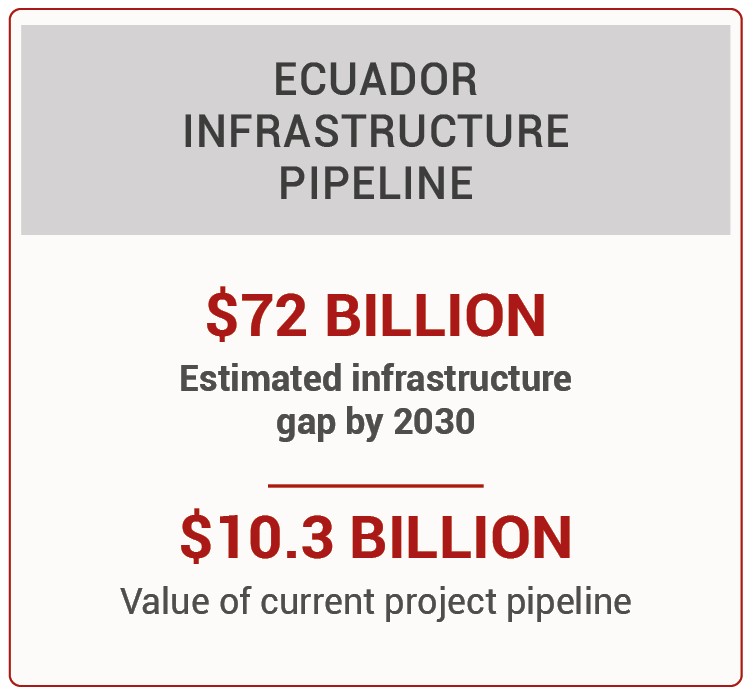
Infrastructure investment remains one of Ecuador’s most pressing development priorities. According to estimates from the Inter-American Development Bank, the country faces an infrastructure gap of approximately $72 billion by 2030. This gap reflects the difference between existing infrastructure and what is needed to sustain long-term economic growth.
To address this challenge, Ecuador’s government has introduced a pipeline of 15 major projects valued at approximately $10.3 billion, many of which are open to international investors through public–private partnership models.
Among these projects are:
- Eight highway and road construction initiatives
- Three port development projects
- Two energy-sector projects
- Two municipal infrastructure initiatives
Particularly notable projects include the Multipurpose Bulk Terminal of Guayaquil, the Commercial Port of Esmeraldas, and the Galápagos logistics and supply system. These projects aim to improve Ecuador’s connectivity, strengthen trade routes along the Pacific coast, and enhance the country’s role in regional and global supply chains.
Economic analysts emphasize that infrastructure investment can act as a macroeconomic catalyst. Large-scale construction projects generate employment, stimulate local industries, and improve productivity by reducing transportation and logistics costs. Estimates suggest that every $1 billion invested in infrastructure may generate approximately 35,000 direct jobs, highlighting the broader economic impact of such initiatives.
Ecuador’s Trade Landscape
Understanding Ecuador’s current trade structure provides important context for potential cooperation with India. Traditionally known for petroleum exports, Ecuador’s export profile has diversified in recent years.
Economists highlighted that non-oil exports now play a significant role in the national economy. The European Union currently represents the largest destination for Ecuador’s non-oil exports, valued at approximately $6.6 billion, followed by the United States ($5.9 billion) and China ($5.3 billion).
Interestingly, Ecuador’s top export product has shifted away from petroleum. Shrimp exports have recently surpassed oil as the country’s leading export commodity, followed by cocoa and bananas. This shift reflects Ecuador’s growing focus on agricultural exports and value-added food products.
Ecuador has also pursued an active trade diplomacy strategy by negotiating agreements with several international partners, including China, Saudi Arabia, Chile, Canada, and the United States. These agreements aim to expand market access, attract investment, and diversify Ecuador’s economic partnerships.
India’s Expanding Presence in Latin America
India’s growing interest in Latin America reflects broader changes in global economic geography. As one of the world’s fastest-growing major economies, India has increasingly sought trade and investment partnerships beyond Asia.
According to representatives from the Export–Import Bank of India (EXIM Bank), India’s total merchandise trade reached approximately $1.1 trillion in 2024, with a long-term goal of surpassing $2 trillion by 2030. Latin America and the Caribbean (LAC) region plays an increasingly important role in this strategy.
Indian investments in the LAC region currently total around $50 billion, with projections suggesting that this figure could exceed $100 billion by 2030. Key sectors include natural resources, energy, infrastructure, pharmaceuticals, and information technology.
For India, Ecuador offers access to valuable mineral resources, agricultural products, and strategic Pacific trade routes. Conversely, Ecuador benefits from India’s technological capabilities, affordable healthcare solutions, and expanding industrial capacity.
Educational and Human Resource Cooperation
Beyond trade and investment, the India–Ecuador relationship also includes important educational and human development initiatives. One such program is the Indian Technical and Economic Cooperation (ITEC) initiative, which provides training programs and scholarships for professionals from developing countries. Through ITEC, Ecuadorian professionals have gained access to specialized training in fields such as technology, governance, and public administration. These programs contribute to knowledge exchange and capacity building, strengthening the human dimension of bilateral relations. Such educational cooperation highlights the broader significance of international partnerships that extend beyond economic interests to include intellectual and cultural exchange.
"New partnerships between emerging economies are reshaping the global trade landscape."
The coming years are expected to bring further institutional dialogue between the two countries. Upcoming meetings such as the Sixth Political Consultations and the Third Joint Economic and Trade Committee (JETCO) in New Delhi aim to address regulatory barriers, improve market access, and strengthen long-term cooperation frameworks. For students and scholars of international relations, the India–Ecuador partnership provides an interesting example of how emerging economies are redefining global economic connections. The future of trade will likely depend on how countries adapt to technological innovation, geopolitical changes, and the growing need for sustainable and inclusive economic cooperation.
Aditi Raman Shridharis an Indian journalist and education living in Ecuador with her family. Her articles focus on human-centered journalism, international relations and cross-cultural storytelling. She also teaches english courses through her platform English Made Easy.