

Business people and entrepreneurs usually spend a lifetime creating and developing their business activities not only pursuing a return on investment (ROI) but also following their passion for their day-to-day activities. The final result, after decades in some cases, is accumulated wealth. However, people sometimes wrongly assume that a Last Will is enough to protect their financial legacy. Sadly, some families lack a well-designed wealth management succession plan, leaving heirs at a significant disadvantage.
According to Ecuadorian civil law, in that scenario, family members must apply for posesión efectiva (a notarial or judicial act that formally recognizes the heirs). On the other hand, in Anglo-Saxon countries like the United States, families may need to go through probate (the court-supervised process of settling a deceased person’s estate, with or without a will).
Both scenarios often turn into a strong administrative and financial dilemma. They can be expensive, time-consuming, and fiscally costly for inheritors. Without enough liquidity during that period, assets and wealth can fall into a legal limbo while the corresponding legal and administrative procedures are completed.
Succession starts immediately upon death, as established under Article 997 of our Civil Code. However, if there is a lack of a Last Will, family members will not be able to get immediate specific ownership of each individual asset. Instead, inheritors must go to a Notary Public Office and present the required documents to obtain what is commonly referred to as posesión efectiva, while the hereditary estate may remain in proindiviso (undivided co-ownership). This legal status is recognized under Article 1263 of the Civil Code, under which hereditary assets are held and administered jointly. All heirs have rights over the hereditary estate, but no individual heir holds absolute ownership over a specific asset until the estate is divided and allocated.
Under Article 36 of the Ley de Régimen Tributario Interno (LRTI, Internal Tax Regime Law), inheritance tax is triggered when heirs accept the inheritance, expressly or tacitly, even while the estate remains in proindiviso. For fiscal year 2026, the base fraction (the tax-free threshold) is USD 78,527. Above this threshold, progressive tax rates apply, reaching up to 35% of the net inherited wealth of each beneficiary.
Financial pressure emerges here, because taxes are assessed on each beneficiary even though the assets themselves may remain in proindiviso. This means that heirs commonly have to pay certain amounts of taxes before they can get proper legal access to the inherited properties, or even any liquidity inside the banking system.
Certainly, a Last Will is a much better scenario than having nothing at all. The testator can designate an executor (albacea) to carry out his or her final wishes. Under Article 1037 of the Civil Code, a Last Will is a solemn act through which the testator establishes, in advance, how the estate will be distributed.
In most U.S. states, the testator has broad freedom to decide whether relatives receive 100% or even 0% of the estate, although certain statutory protections may apply, particularly to a surviving spouse. A testator may even leave the disposable estate to a close friend or a charity. In Ecuador, however, our legal framework is quite different.
«A last will provides greater control over how wealth is distributed, but it does not eliminate inheritance tax obligations or prevent delays. Strategic estate planning can help protect family wealth and ensure a smoother transfer of assets to future generations.»
Our Civil Code is very sharp. Under Article 1194, the law establishes mandatory allocations involving the cónyuge (spouse), the legítima rigurosa (the strict forced-heirship share reserved by law), and the cuarta de mejoras (a quarter reserved for improvements among descendants). Under Article 1207, 50% corresponds to the legítima rigurosa and 25% to the cuarta de mejoras. Therefore, a significant portion of the estate is subject to mandatory allocations, leaving 25% as the cuarta de libre disposición (the freely disposable quarter) for the testator’s wishes.
In most cases, the testator has more control through a Last Will than intestate succession allows. A Last Will improves the picture by giving the testator greater authority to determine how the estate should be distributed, subject to Ecuador’s forced-heirship rules. Nevertheless, the testator’s death does not eliminate the inheritance tax obligations previously discussed. The type of will, whether open or closed, may also affect the related formal and notarial costs. If disputes arise among the heirs, the matter may ultimately require judicial proceedings.
In the U.S., estate planning is widely used to avoid or simplify probate proceedings, reduce costs and delays, and limit uncertainty about how wealth will be transferred to beneficiaries. In some cases, depending on the structure and applicable tax rules, estate planning may also provide tax-planning opportunities.
In our local jurisdiction, this is precisely where Ecuador’s irrevocable mercantile trust (fideicomiso mercantil) becomes so relevant. It can be described as a hand-tailored suit, designed around the needs of each grantor, and it is governed by Book II of the Código Orgánico Monetario y Financiero (COMF, Monetary and Financial Code). Under Article 109, through this contract the grantor, known in Ecuador as the Constituyente and in the U.S. as the Settlor, temporarily and irrevocably transfers properties, assets, brands, patents, or other tangible or intangible assets to an autonomous patrimony (a separate legal estate) created for that purpose. The grantor may also be one of the beneficiaries. The trust company, acting as trustee, legally represents that patrimony and administers it with diligence and prudence, following the purposes established by the grantor in the trust agreement.
Figure 1.
Two Different Succession Architectures.
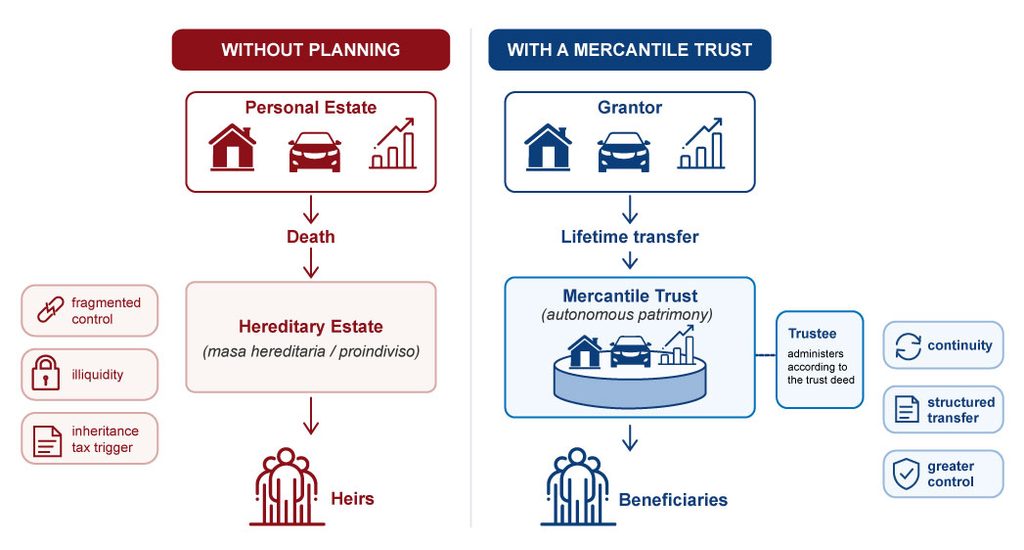
A well-designed trust structure differs sharply from the commonly known inheritance methods, intestate succession or a Last Will. Under Article 118 of the COMF, the assets contributed to the trust form an autonomous patrimony, legally separate from the grantor’s own assets and from those of the trustee and the beneficiaries. As a result, heirs are no longer co-owners of an undivided estate; they become beneficiaries with the rights defined in the trust agreement. Intestate succession and Last Wills, by contrast, usually end in fragmentation, illiquidity, and delay, or in litigation among heirs, as illustrated in Figure 1.
Under Article 119, the trust itself is the legal owner of the assets inside the autonomous patrimony, and the trustee exercises its legal representation. The trustee must also report to the Constituyente and, more importantly, to the Superintendencia de Compañías, Valores y Seguros (SCVS, Ecuador’s securities and companies regulator agency), as established by law and the trust agreement itself.
To illustrate the trust structure, consider a person with a USD 300,000 real estate property, a USD 100,000 vehicle, and a USD 400,000 stock market portfolio. He or she may transfer those assets into a trust while still alive. When the applicable legal formalities require it, the assets are transferred to the trust through a public deed and subsequently registered in the name of the autonomous patrimony. Securities may also be registered through Ecuador’s capital market infrastructure, including Decevale or DCV-BCE.
Under Article 113 of the COMF, transfers made by the grantor to constitute a mercantile trust are considered neither onerous nor gratuitous (that is, treated neither as a sale nor as a gift). The law provides specific tax and fee treatment for these transfers, including exemptions applicable to certain real estate transfer taxes and registration charges upon the establishment of the trust. Transfers subsequently made to beneficiaries remain subject to the tax rules applicable to each transaction.
This structure is administered by an authorized fund and trust management company acting as trustee and supervised by the SCVS. Under Article 120 of the COMF, the trust agreement must identify, among other elements, the grantors, beneficiaries, and the terms and conditions governing the trust. One of the most relevant attributes of a trust is its flexibility to establish how and when assets or economic benefits will be transferred to beneficiaries. This flexibility may also support long-term tax planning, subject in every case to the tax rules applicable to each distribution.
Figure 2.
Trustees in Ecuador.
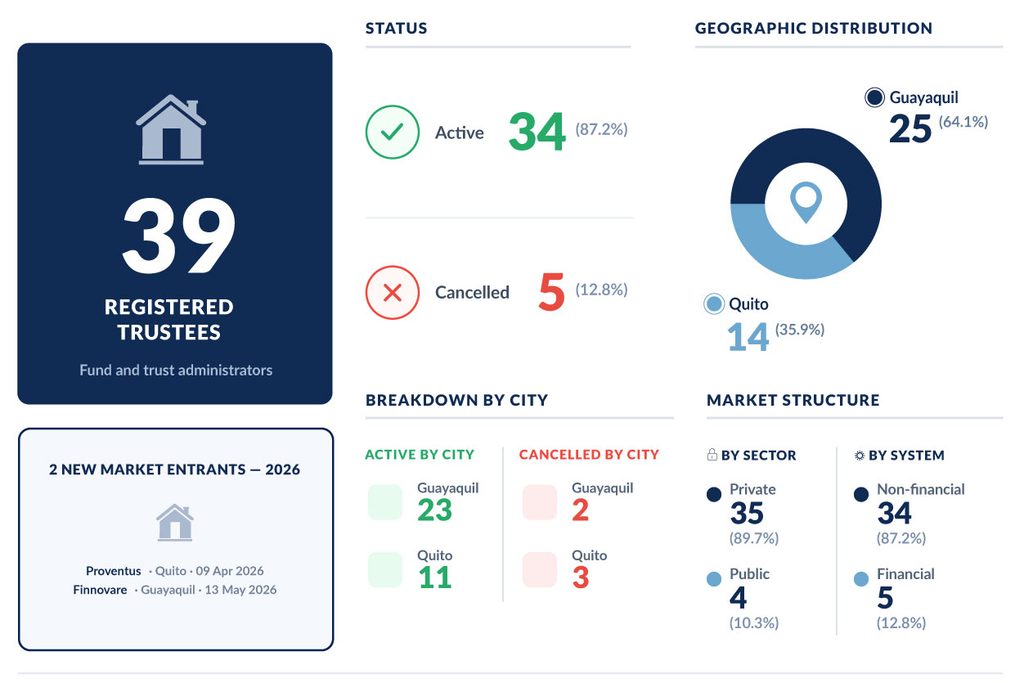
Report date: 2026-09-02. – Includes 2 trustees registered in 2026. – (Proventus: 09 Apr · Finnovare: 13 May).
Ecuador’s fiduciary sector is very active and growing steadily. Within this fiscal year alone, two new trustees have entered the market, suggesting that the trust industry is not only highly competitive, but also has room for further market growth. As shown in Figure 2, as of September 2026, the SCVS registers 39 fund and trust administrators, of which 34 are active.
As previously reviewed, intestate succession may involve limited flexibility, higher costs, delays, and legal procedures that families may find difficult to manage. A Last Will gives the testator greater control, but it does not necessarily reduce the applicable inheritance tax burden. Above all, a well-designed trust can operate as a hand-tailored succession-planning structure, providing continuity, legal certainty, and transparency. Rather than waiting until death to organize the transfer of wealth, a trust allows the settlor to establish during his or her lifetime how assets will be administered and ultimately transferred to beneficiaries.
Finally, succession should not be improvised at the last moment. Mercantile trusts, as modern legal, financial, and tax planning instruments, allow families to structure the management and transfer of wealth more strategically, and therefore deserve broader discussion within Ecuadorian society.